
One appointment.Every hand it passes through.
Laseera is the operating system for laser, skin and dermatology clinics. Reception, the treatment room, the wallet, the stock room and the month’s reporting all work from the same record — across one branch or a dozen, in Arabic or English.


What Laseera is built for
Arabic first, and right-to-left for real
Arabic is the default language and the default direction. The whole interface mirrors from one stylesheet — not a translated skin bolted onto an English product.
Built for more than one branch
Branches, rooms, stock and rotas are separate from day one, and one account can hold several. A doctor working at two clinics is a supported case, not a workaround.
Packages counted in pulses, not guesses
Laser packages sell and draw down in pulses as well as sessions, on an append-only ledger. What a patient has left is a balance, not a note in the margin.
Every clinic’s data isolated in the database
Separation is enforced by row-level security on every clinic-owned table, and the server refuses to start if a table is missing its policy.
One appointment, from her sofa to your month end
This is a single 15:00 Hydrafacial, followed through every hand it passes. Nothing below is retyped, re-entered or reconciled — each step reads and writes the same record, which is the whole reason the last step needs no work at all.
- 21:40the night before
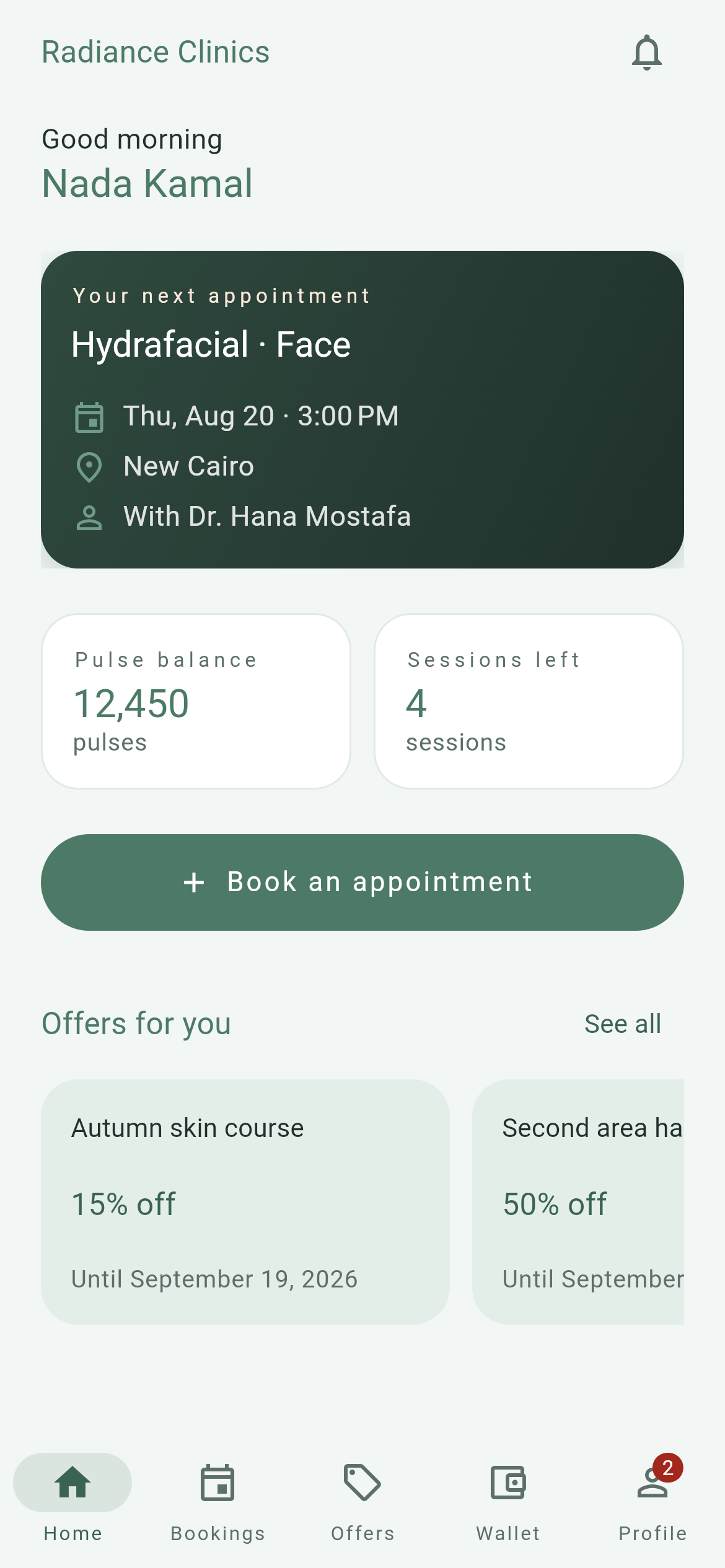
Nada books from her sofa
She opens the clinic’s own app, sees what she has left, and takes a 15:00 slot. Nobody at the clinic is awake, and nobody has to be — availability comes from the real rota, so the slot she takes is a slot that exists.
- 08:02the next morning
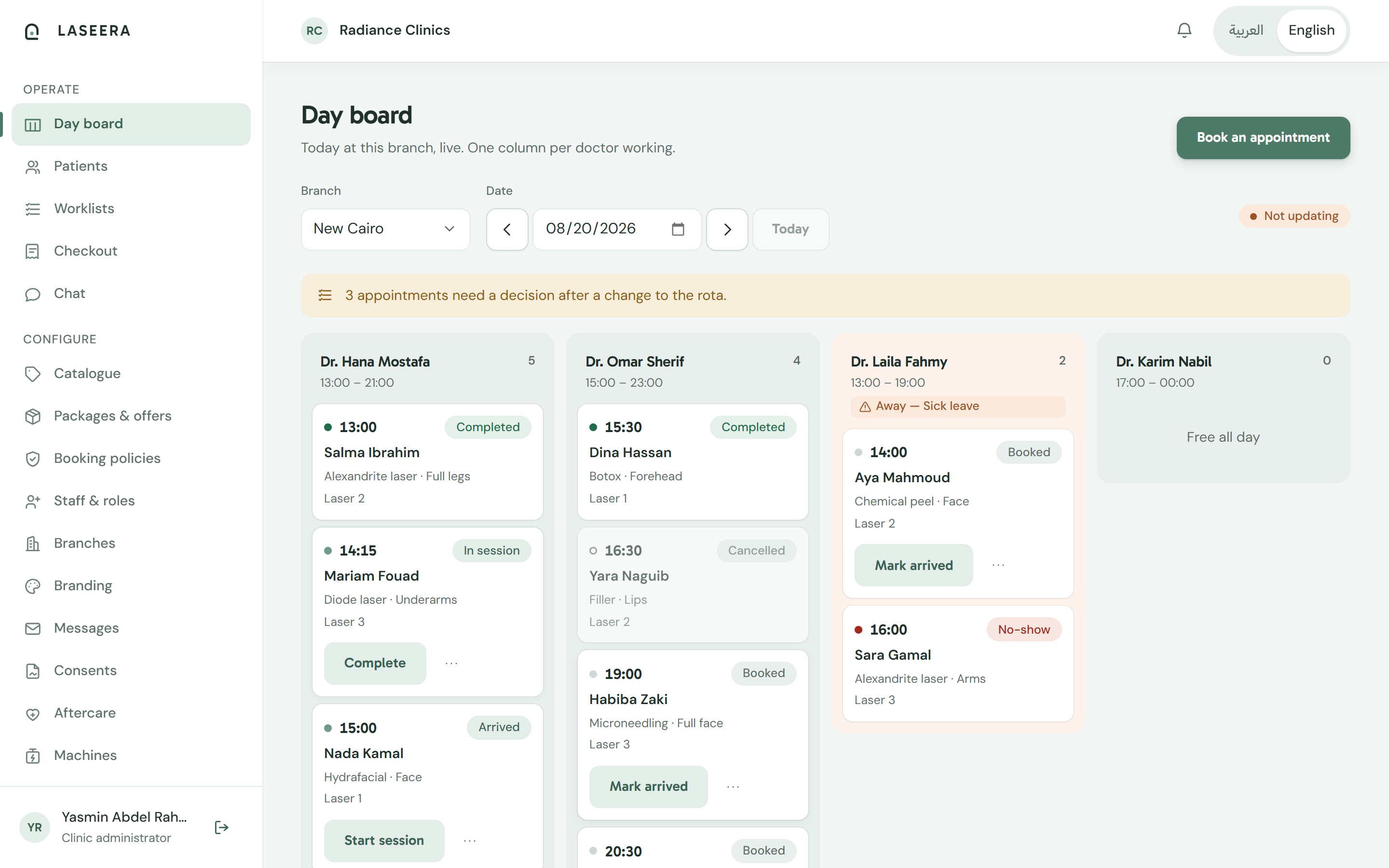
The desk opens the day board
One column per doctor working, live. Her 15:00 is already there, in the room it needs, and no one retyped it. The board updates itself as the day moves rather than waiting for someone to refresh.
- 11:15
The day changes, and nothing goes quiet
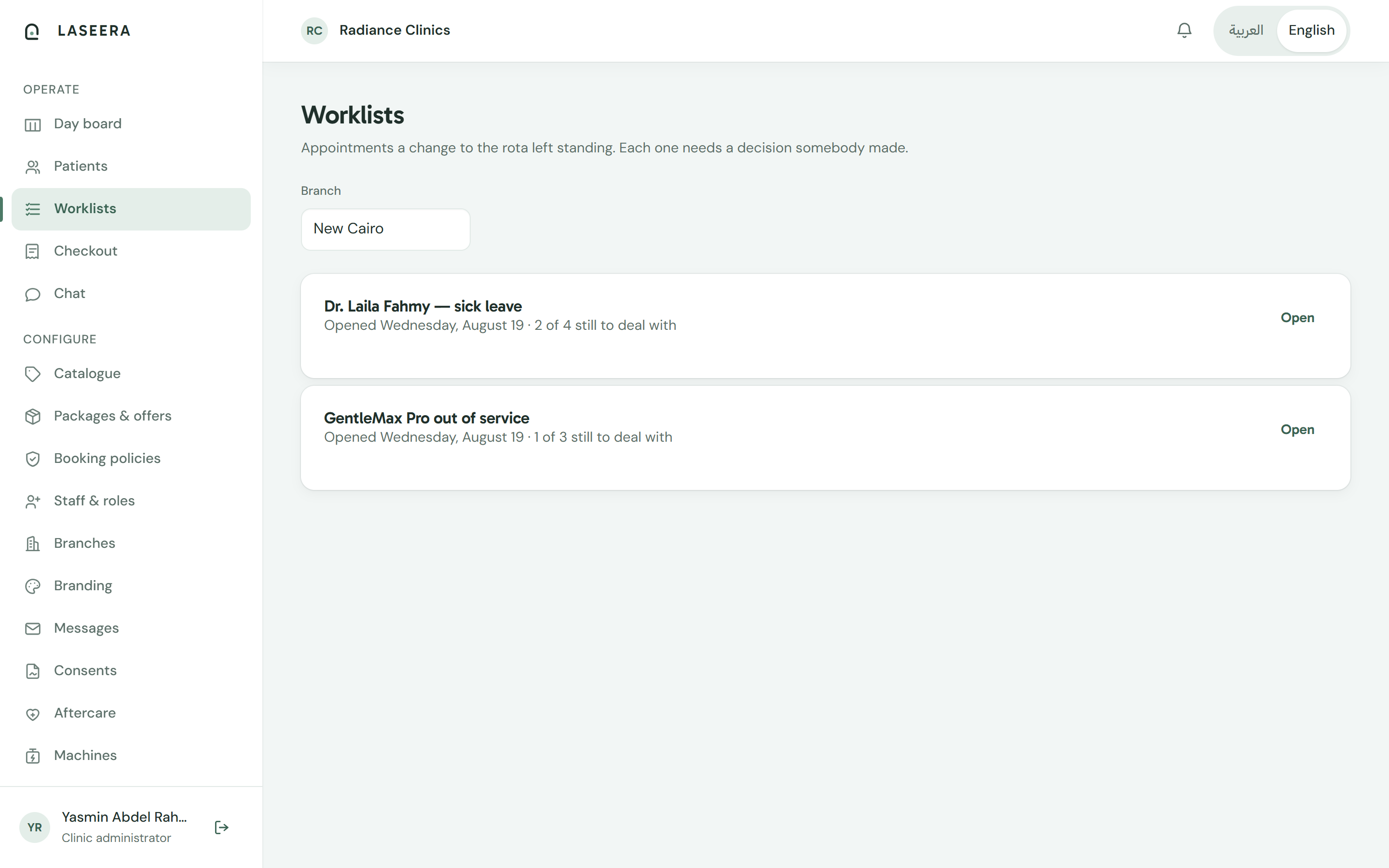
A doctor calls in sick; a laser goes out of service. Neither becomes a phone tree — both land on the worklist with the appointments they affect, counted, so somebody decides rather than somebody discovers.
2 of 4 still to deal with
- 15:02
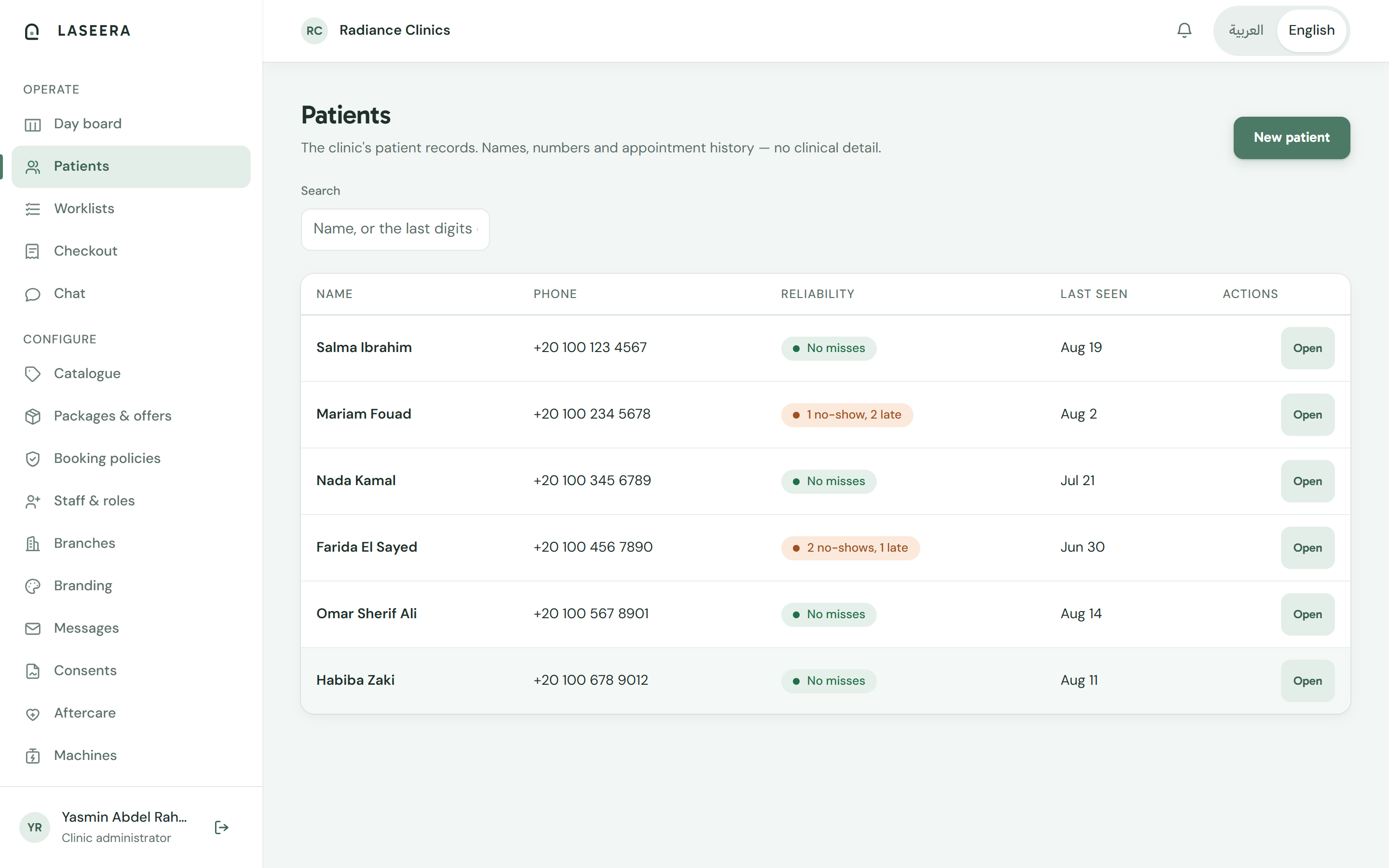
The room already knows her
Her history, her signed consent, her patch test and her aftercare are on the same record the desk booked. The practitioner records what was treated and which machine did it, and that is the end of the paperwork.
- 15:47
The pulses come off the ledger
Not off a spreadsheet. The deduction is an entry on an append-only ledger, priced at what she actually paid for the package — so re-pricing it next quarter cannot move last quarter’s figures.
- Month end
The report already has it
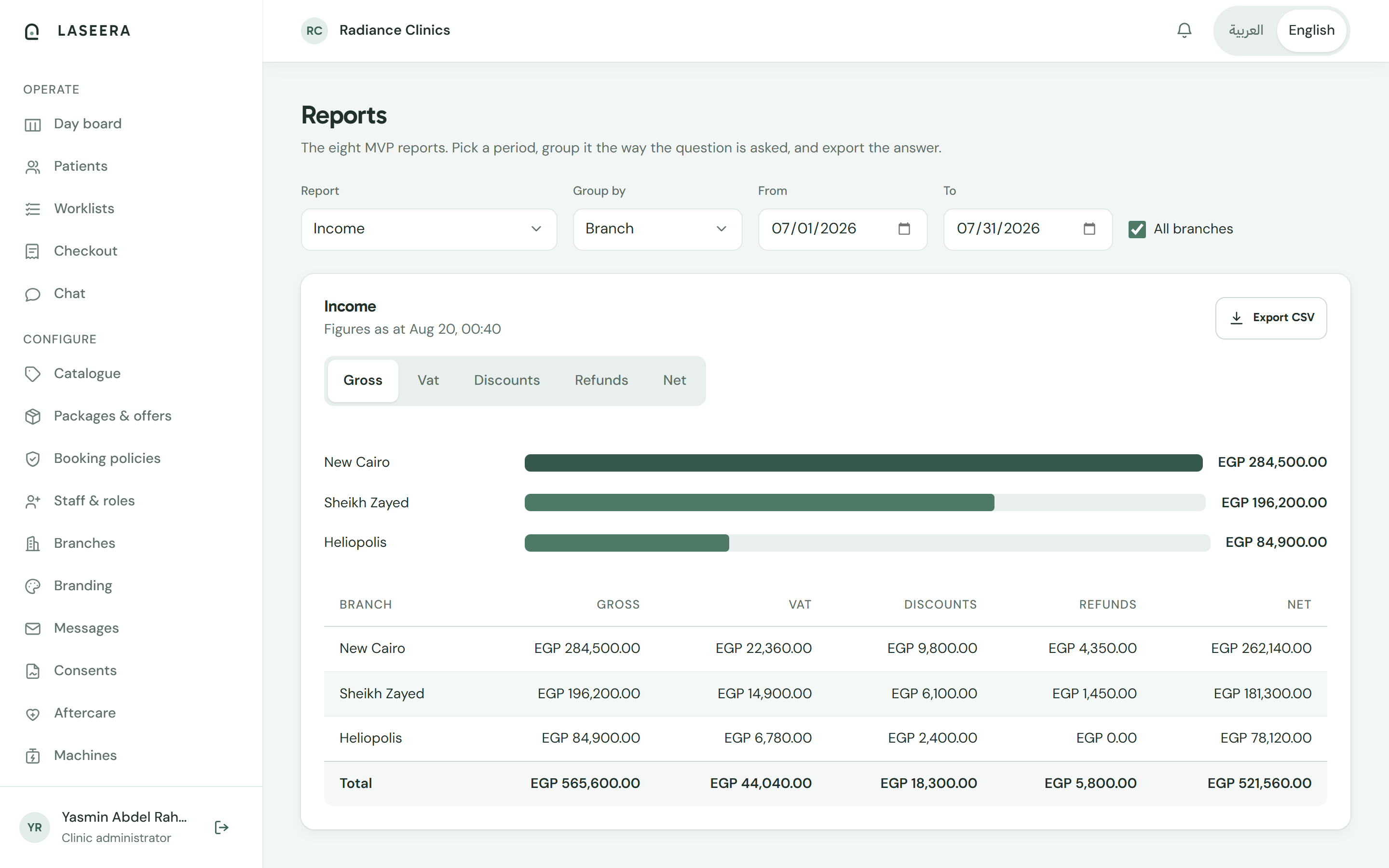
Because every step above wrote to the same record, the month closes without anyone assembling it. Eight reports, doctor statements and a CSV export, from the data the day produced on its own.


See the whole clinic, one screen at a time
The staff dashboard, as it ships. Every screen below is a real capture of the running product against its demonstration clinic — nothing here is a drawing of what it might look like.
The day, as it is actually going
One column per doctor working. Every card carries the one action that makes sense next — mark arrived, start, complete — so the desk is never deciding what to click. It is live: a change made in a treatment room shows at the desk without a refresh.
What it actually takes off the desk
Six things a clinic loses time to every week, what Laseera does about each, and what changes as a result.
Appointments that survive a change of plan
A doctor calls in sick and the day becomes a phone tree.
Every affected appointment lands on a worklist. A reassignment needs the replacement practitioner’s agreement first, then the patient’s — and staff can record either answer on someone’s behalf, audited as such.
The rota changes once and everyone downstream is told, in order.
A safety chain that is enforced, not filed
Patch tests, intake answers and consents live in a folder nobody opens mid-shift.
Laser bookings check them in the booking path. Reception is asked to state why a booking is safe before it will take one; consent is versioned, and a signature stores a hash of the exact text signed.
What was agreed, and when, is answerable years later.
Money that adds up without a second ledger
Packages, part-payments and refunds get reconciled by hand at month end.
One append-only ledger carries pulses, sessions, sales, payments and refunds. Refunds need an approver who is not the requester. Receipt numbers are gapless per branch.
The drawer, the report and the patient’s balance cannot disagree.
Stock and machines that speak to the rota
A handpiece runs out, or a laser goes in for service, and nobody tells the diary.
Stock moves on a provable balance; transfers between branches need both ends to confirm. Machine downtime is a period, so maintenance booked today removes the slots it will affect next week.
The clinic stops selling time it cannot deliver.
Messages the clinic does not have to remember to send
Reminders are somebody’s WhatsApp job, and it is the first thing dropped on a busy day.
Reminders are written at the moment of booking with a future send time, and withdrawn automatically when an appointment moves or is cancelled. Broadcasts and staff–patient chat run through the same engine.
Nobody is reminded about an appointment that no longer exists.
A record of who did what
Something changed, and the only account of it is people’s memory.
An append-only audit log records the action, the actor, the clinic and whether it was done on someone’s behalf. Staff permissions are a matrix, not a single admin switch.
Questions about last month have an answer that is not an argument.
Your clinic, in her pocket
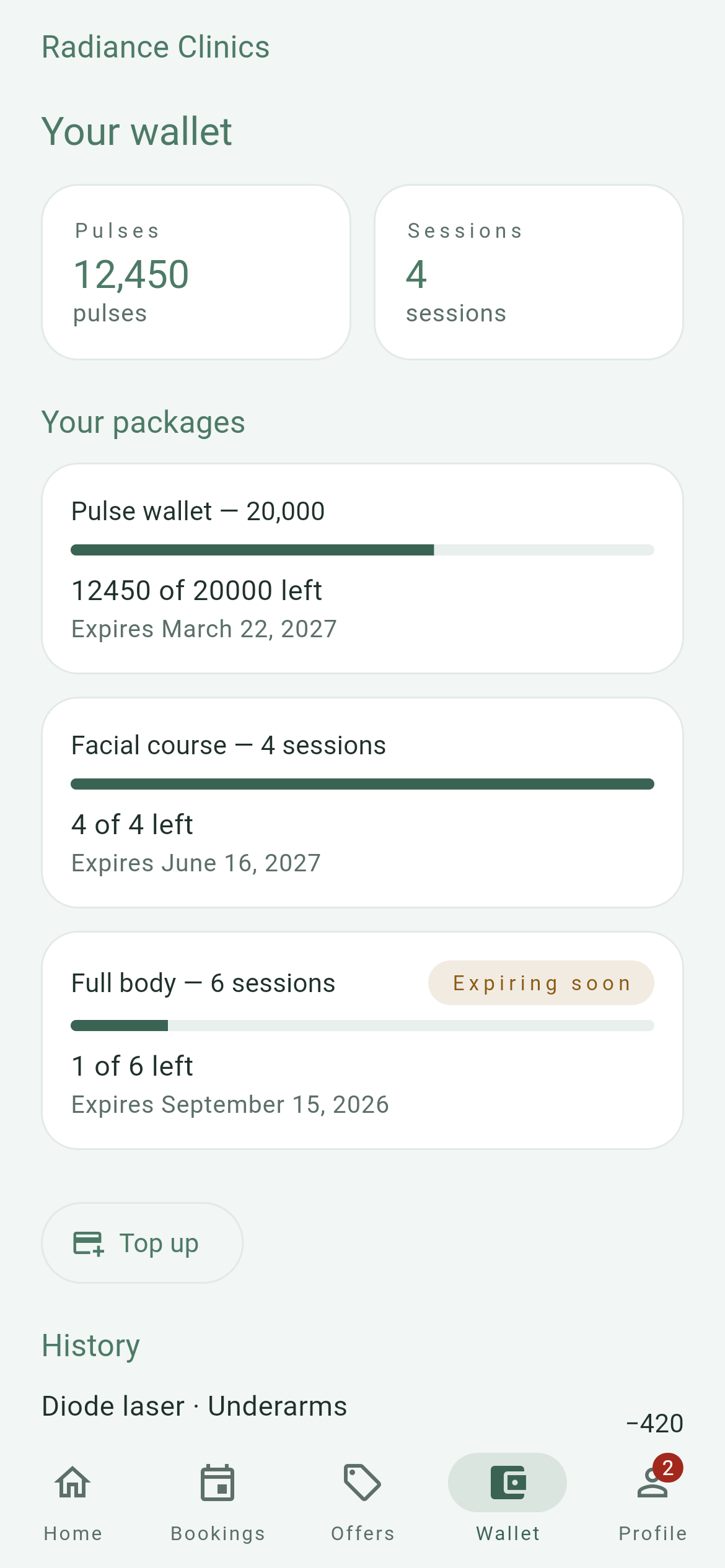
The client app carries your clinic’s name, not ours. It shows a patient what she has booked, what she has left and what her clinic has told her — from the same records your desk is working in. She books within your policies, on your real availability.
What she has booked
Upcoming and past visits, with the branch and the practitioner, and rescheduling inside your rules.
What she has left
Pulse and session balances against each package she bought, with a warning before one expires.
Booking that respects the rota
Slots come from real availability, so a booking she makes at midnight is one the clinic can keep.
A line to the clinic
Reminders, offers and aftercare arrive in the app, and she can message the clinic back.


The client app and a separate app for practitioners are both built and running. Neither is in the App Store or on Google Play yet — we will tell you exactly where that stands on the call.
Two branches should not mean two systems
Multi-branch is in the model rather than in a higher tier. It is the same product whether you run one room in Zamalek or three addresses across Cairo and Giza.
A branch is a real boundary
Its own rooms, rota, stock and receipt sequence. Closing one for a week does not disturb the others, and opening a fourth is a form, not a migration.
One account, every address
Staff move between branches without a second login, and a practitioner working at two clinics gets a warning when the two rotas collide rather than a double booking.
Read one branch or the whole group
Every report takes a branch filter. Packages a patient bought at one branch are redeemable at any of them, because the balance belongs to the clinic, not the address.

العربية first, not translated afterwards
Arabic is the default language and the default direction. The interface mirrors from a single stylesheet — the same components, laid out right to left — so nothing drifts out of alignment between the two languages, and staff switch between them mid-shift without leaving the screen they are on.
The patient app follows the same rule. Arabic is what a patient sees unless she asks for English.

Built to hold clinical records
These are engineering facts about how Laseera is put together, not certifications. Where a licence or an audit is required and not yet held, we will say so plainly rather than imply otherwise.
- Isolation enforced by the database
- Every clinic-owned table carries row-level security with a policy. A start-up guard checks this on every boot and refuses to run if a table is missing one.
- Clinical text encrypted at the column
- Session notes and other clinical free text are encrypted before they reach the database, not only in transit and at rest on the disk.
- Photographs held privately
- Clinical photographs upload through the API so location data can be stripped, are stored in private object storage, and are only ever handed out on links that expire in minutes.
- Permissions as a matrix
- Roles are built from individual permissions, so a receptionist can take a payment without reading a clinical note and a practitioner sees their own statement, not the team’s.
- An audit log that cannot be edited
- Actions are appended, never updated. The record includes who acted, in which clinic, and whether they were acting on someone else’s behalf.
- Hosted where you can point at it
- Laseera runs on dedicated hardware in France — not a shared multi-tenant cloud — with encrypted transport throughout. Support access is granted to a named person, for a set time, with a stated reason, and it is written to the audit log like anything else.
Questions clinic owners actually ask
If yours is not here, it is a good first question for the call — we would rather answer it properly than guess at it in a paragraph.
Software. Laseera does not treat anyone and does not give clinical advice. It is the system a laser, skin or dermatology clinic runs its operation on — its appointments, its patients, its packages, its stock and its reporting.
No. Branches are part of the model rather than an upgrade: each has its own rooms, rota, stock and receipt numbering, and your staff move between them on one account. Reporting can be read per branch or across the group.
Arabic is the default. The interface mirrors right-to-left throughout, including the patient app, and validation messages come back in Arabic unless the browser asks for English. It is not a translation layer added afterwards.
Bring it to the call. Patients, services, prices and package balances are the four things worth moving, and we will tell you honestly what can be imported and what will need to be entered — before you commit to anything.
Yes. Patient bookings obey the same policies and the same real availability as the desk’s, and anything that needs a human decision — a first laser booking, a missing patch test — arrives on the worklist rather than being silently accepted or silently refused.
We do not publish a price list, because what a clinic pays depends on how many branches and practitioners it runs. Book a demo and you will get a figure on the call, not after a sequence of emails.
See it against your own Wednesday
A demo is a working system with your clinic’s shape in it — your branches, your treatments, your rota — not a slide deck. Thirty minutes, and you will know whether this fits.
- A working system with your branches and treatments in it, not slides.
- A straight answer on what your current data can and cannot bring across.
- A price on the call.
Would rather not fill in a form? Write to hello@laseera.com with your clinic’s name and how many branches you run, and we will take it from there.